

5 Ways to Increase Your Self-Awareness
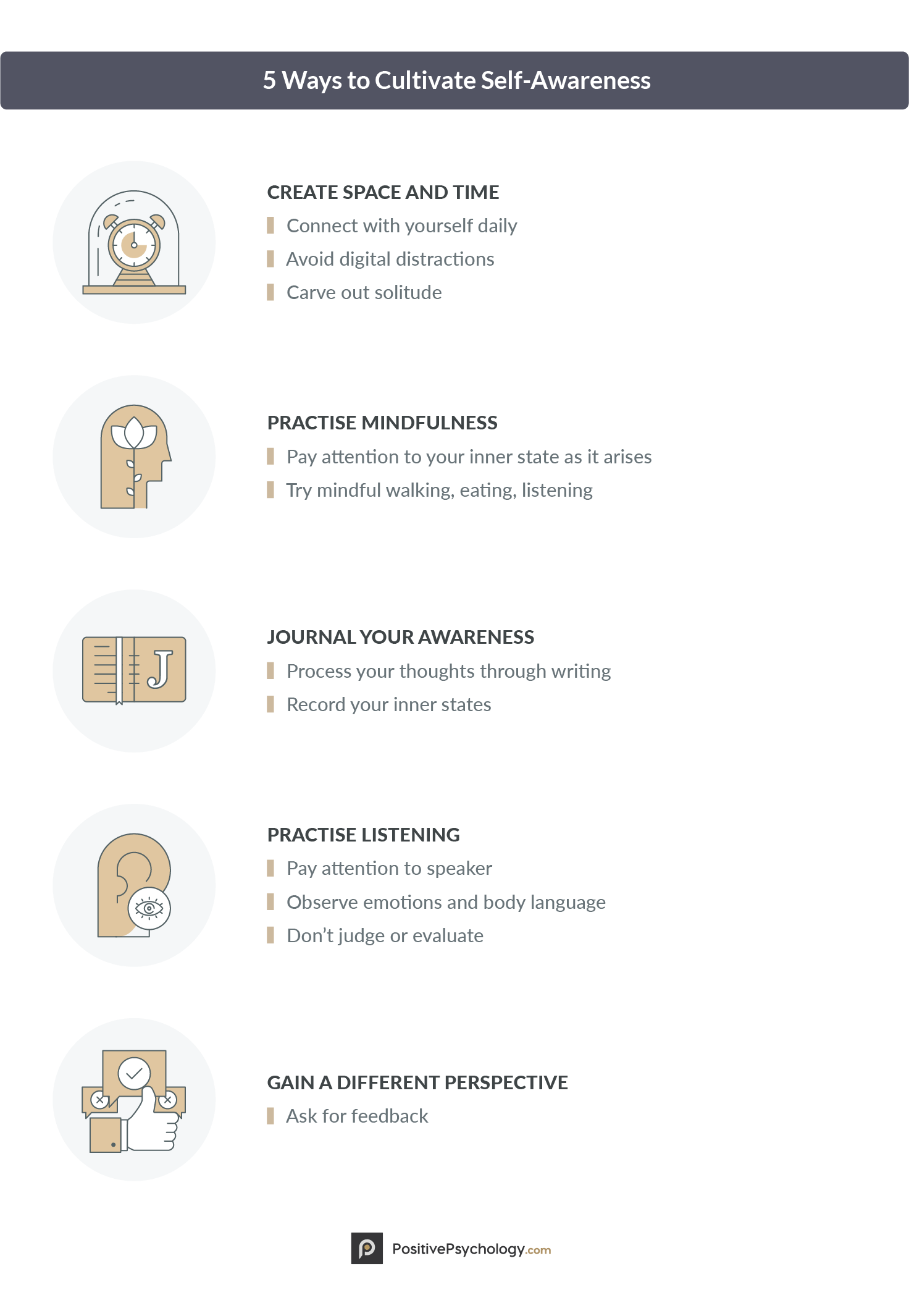 Now we have some clear-cut examples of self-awareness in mind. We know what it looks like to embrace self-awareness and grow. But how do you do it? What did our leading characters do to practice self-awareness?
There are many ways to build and practice self-awareness, but here are some of the most effective:
1. Practice Mindfulness and Meditation
Mindfulness refers to being present in the moment and paying attention to yourself and your surroundings rather than getting lost in thought or ruminating or daydreaming.
Meditation is the practice of focusing your attention on one thing–like your breath, a mantra, or a feeling–and letting your thoughts drift by instead of holding on to them.
Both practices can help you become more aware of your internal state and your reactions to things. They can also help you identify your thoughts and feelings and keep from getting so caught up in them that you lose your hold on your “self.”
2. Practice Yoga
Yoga is a physical practice, but it’s just as much a mental practice. While your body is stretching and bending and flexing, your mind is learning discipline, self-acceptance, and awareness. You become more aware of your body and all the feelings that manifest, and you become more aware of your mind and the thoughts that crop up.
You can even pair yoga with mindfulness or meditation to boost your self-awareness.
3. Make Time to Reflect
Reflecting can be done in multiple ways (including journaling; see the next tip) and is customizable to the person reflecting, but the important thing is to go over your thoughts, feelings, and behaviors to see where you met your standards, where you failed them, and where you could improve.
You can also reflect on your standards themselves to see if they are good ones for you to hold yourself to. You can try writing in a journal, talking out loud, or simply sitting quietly and thinking, whatever helps you to reflect on yourself.
4. Journaling
The benefit of journaling is that it allows you to identify, clarify, and accept your thoughts and feelings. It helps you discover what you want, what you value, and what works for you. It can also help you find out what you don’t want, what is not important to you, and what doesn’t work for you.
Both are equally important to learn. Whether you like to write free-flowing entries, bulleted lists, or poems, writing down your thoughts and feelings helps you to become more aware and intentional.
5. Ask the people you love
It’s vital to feel we know ourselves from the inside, but external feedback helps too. Ask your family and close friends about what they think about you. Have them describe you and see what rings true with you and what surprises you.
Carefully consider what they say and think about it when you journal or otherwise reflect. Of course, don’t take any one person’s word as gospel; you need to talk to a variety of people to get a comprehensive view of yourself.
And remember that at the end of the day, it’s your self-beliefs and feelings that matter the most to you!
Importance in Counseling and Coaching
Self-awareness is a powerful tool that, when practiced regularly, can do more good for coachees and clients than anything else a professional can share with them. To make real, impactful, and lasting change, people need to be able to look inward and become familiar with that internal environment.
Building self-awareness should be a top priority for virtually all clients, after which the more traditional coaching and counseling work can begin. For example, you can counsel someone on their bad habits and give 1,000 ways to break their habits. Still, if they don’t understand why they tend towards these bad habits in the first place, it’s almost a guarantee that they will either never break those habits or will quit for a while and simply pick up where they left off when things get tough.
Self-awareness is not only vital for the coachee or client; it is also important for the coach or counselor. In fact, self-awareness is prioritized as a core standard in the Council for Accreditation of Counseling and Related Educational Programs (CACREP) Standards (2009) for the profession, as both a requirement for counselors and a necessary skill to build in clients. It takes a good amount of self-awareness to give competent counsel and provide actionable advice.
Plus, self-awareness will help the caring counselor from getting too wrapped up in their client’s problems or seeing the issues through their own skewed lens. To truly help someone, it’s essential to see things from their perspective, and that requires being self-aware enough to put our thoughts and feelings aside sometimes.
A Take-Home Message
In short, a little extra self-awareness can be of great benefit to anyone with the will to improve. This piece includes a description of self-awareness, an exploration of the theory of self-awareness, examples, and tips and tools you can use to boost your self-awareness. We hope you find this information helpful in increasing your awareness or the awareness of your clients.
What exercises do you use to help build self-awareness? What are some other benefits you’ve noticed? Let us know in the comments section below.
We hope you enjoyed reading this article. Don’t forget to subscribe to Newsletter


0 Comments